

Walk into just about any store this summer and you’ll find an entire aisle dedicated to hydration. Electrolyte powders, sports drinks, hydration packets…there are more options than ever, and honestly, there are times when those products make perfect sense. If you’ve been working outside all day, running a marathon, or you’ve been sick and losing fluids, they can be incredibly helpful.
Heck, just last week I was doing tree work in Florida, and the heat and humidity were absolutely brutal. I was going through electrolyte packets like they were candy because I simply couldn’t replace fluids as fast as I was losing them. I drank a gallon of water, still barely had to use the bathroom, and by the end of the day I knew my body had taken a beating. So if there’s anybody who understands summer dehydration right now, it’s me. That experience got me thinking.
Before electrolyte powders, sports drinks, and hydration packets were sitting on every store shelf, people were still working outside. They were farming, building homes, tending gardens, raising children, chopping firewood, hauling water, and spending long days in the summer heat. So how did they do it?
The answer isn’t one magical herb. They simply lived differently. Food wasn’t something that came from a drive-thru or a freezer aisle. Meals were made from vegetables grown in the garden, fruit that was actually in season, beans, eggs, meat, fish, homemade soups, nourishing broths, fresh bread, and foods prepared from scratch. Without even thinking about it, they were eating meals rich in protein, healthy fats, fiber, vitamins, minerals, and countless plant compounds.
Many cultures also understood something we’ve forgotten. You don’t always fight the heat. In many warm climates around the world, people traditionally started working early in the morning before the hottest part of the day. As the afternoon heat became intense, they slowed down, rested, shared a meal, drank water or herbal infusions, and returned to work later in the evening when temperatures became more manageable. They were working with nature instead of against it. I have a lot of respect for communities that consider their bodies in respect to their work. An exhausted, depleted worker is no good for work the next day. They also were much more acclimated to warmer temperatures because they didn’t live with the luxury of air conditioning like we do.
These days, most of us do the exact opposite. We stay up too late. We rely on caffeine to keep going. We eat whatever’s convenient because life is busy. We spend all day inside and then suddenly expect our bodies to handle hours in the blazing summer sun without missing a beat. Then we wonder why we’re exhausted, our muscles cramp, our recovery takes forever, and we never seem to feel completely recharged.
As a massage therapist, I hear people say all the time, “I’m just so tight.” Sometimes they are. But sometimes I think their body is asking for more than just a massage. Sometimes they’re just dehydrated or malnourished. Sometimes it’s asking for protein. Sometimes it’s asking for better sleep. Sometimes it’s asking for a little more rest. Sometimes it’s asking for nourishment.
Massage absolutely helps improve circulation, calm the nervous system, and decrease muscle tension. But muscles also need protein to repair. Your nerves rely on minerals like sodium, potassium, calcium, and magnesium to function normally. Your connective tissues need the nutrients that allow them to recover over time. We can’t expect our bodies to perform well if we never give them the raw materials they need.
Now, before somebody jumps into the comments, no…I’m not saying a cup of herbal tea replaces an electrolyte packet after you’ve spent ten hours working outside in July. That’s not what I’m saying at all. I’m talking about nourishment. I’m talking about the little things we do consistently that help build a healthier, more resilient body over time.
That’s one of the reasons I’ve loved herbalism for so many years. Herbs aren’t magic. They don’t replace healthy food. But they are another way to nourish the body. Herbs are to be taken in addition to your already healthy lifestyle. You can’t take an herb and expect it to work like a standard allopathic medication.
One of the herbs you’ll almost always find in my cabinet is nettle. Herbalists have treasured nettle for generations because it’s naturally rich in minerals like magnesium, calcium, potassium, iron, and silica. When I drink nettle, it doesn’t feel like taking a supplement. It has this really earthy flavor that feels nourishing.
I also love oatstraw. Oatstraw naturally contains minerals like calcium, magnesium, and silica and has traditionally been used as a deeply nourishing herb. After several days of massage clients or a long day working outside, it’s one of the first herbs I reach for. Oatstraw tastes exactly how it sounds. It smells and tastes like a dried grass.
Red raspberry leaf is probably one of the most misunderstood herbs out there. Most people only associate it with pregnancy, but it’s a wonderful everyday herb for almost anyone. It naturally contains minerals like calcium, magnesium, potassium, and manganese, and it blends beautifully with almost every nourishing tea.
During the summer, I almost always add hibiscus. Besides turning the tea the prettiest deep ruby color, it has a bright, refreshing flavor that’s perfect over ice. It also naturally contains vitamin C and antioxidant compounds, making it one of my favorite herbs for hot weather. Hibiscus is the base for a lot of herbal teas because it has such a nice flavor and adds so much color.
Sometimes I’ll include a little alfalfa, which has long been appreciated as a nutrient-dense herb with a broad range of naturally occurring vitamins and minerals. It adds another layer of nourishment without overpowering the blend. This is another one that tastes just like grass so be prepared not to love this one.
You’ll also notice I only use a small amount of sage. Most people think of sage as something that belongs in Thanksgiving stuffing, but herbalists have traditionally used it to help support the body’s natural response to summer heat and to help with excessive sweating. It’s a very cooling herb. It has a very bold flavor, so a little goes a long way, but I think it adds something really special to this blend.
If I’m making a larger batch, I sometimes add just a touch of horsetail. Horsetail has traditionally been valued because it’s naturally high in silica, a mineral that’s important for connective tissues. Since I spend my days working with muscles and fascia, that connection has always fascinated me. I keep it optional simply because a little is all you need. The added bonus that horsetail offers is that it’s also excellent for hair growth.
Finally, I finish the blend with either peppermint or spearmint. Besides making the tea taste amazing, they add that fresh, cooling flavor that just feels right on a hot summer afternoon.
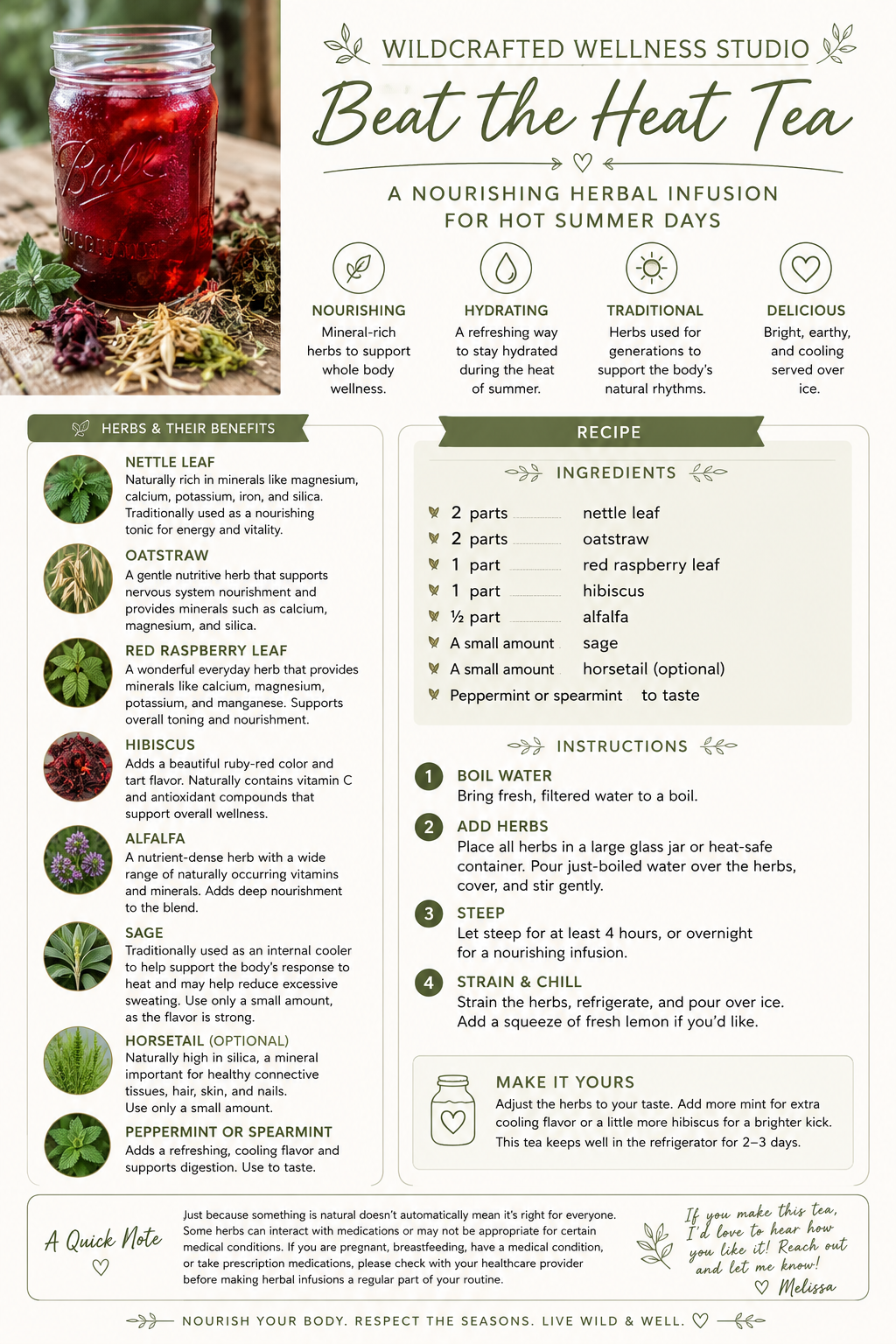
Wildcrafted Wellness Studio “Beat the Heat” Herbal Tea
2 parts nettle leaf
2 parts oatstraw
1 part red raspberry leaf
1 part hibiscus
½ part alfalfa
A small amount of sage
A small amount of horsetail (optional)
Peppermint or spearmint to taste
Pour just-boiled water over the herbs and let them steep for at least four hours, or overnight if you’re making a nourishing infusion. Strain, chill, and pour over ice. I love adding a squeeze of fresh lemon after a long day outside.
This tea keeps well in the refrigerator for a couple of days, so I’ll usually make a big batch and keep it ready to grab after working in the Georgia or Florida heat.
I used to think that I had to drink my teas hot, but honestly, I really only like hot tea during the winter. Once I started making big batches of tea and refrigerating them, I started being more consistent with getting my daily herbs in.
A quick note before you start brewing… Just because something is natural doesn’t automatically mean it’s right for everyone.
Some herbs can interact with medications or may not be appropriate for certain medical conditions. For example, hibiscus may lower blood pressure in some people, and herbs like nettle or alfalfa can interact with certain medications. If you’re pregnant, breastfeeding, have a medical condition, or take prescription medications, it’s always a good idea to check with your healthcare provider before making herbal infusions a regular part of your routine.
At the end of the day, this isn’t about finding one miracle tea. Our bodies thrive when we consistently give them what they need. Real food. Plenty of protein. Good sleep. Movement. Rest. Water. But a nice mineral rich tea sure does help!
If you decide to make this tea, I’d love to hear what you think. Did you change anything? Add a favorite herb? Love it? Hate it? Let me know! I’m always curious to hear how other people make these recipes their own.