

If you’ve been dealing with sciatic pain for weeks, months, or even years, you’ve probably asked yourself, “Why does this keep coming back?”
Maybe you’ve stretched every day. Maybe you’ve taken pain medication, used a heating pad, bought a massage gun, or had a massage that helped for a few days, only to have the pain slowly creep back.
In my experience, that’s usually because we’re focusing on the symptom instead of the cause.
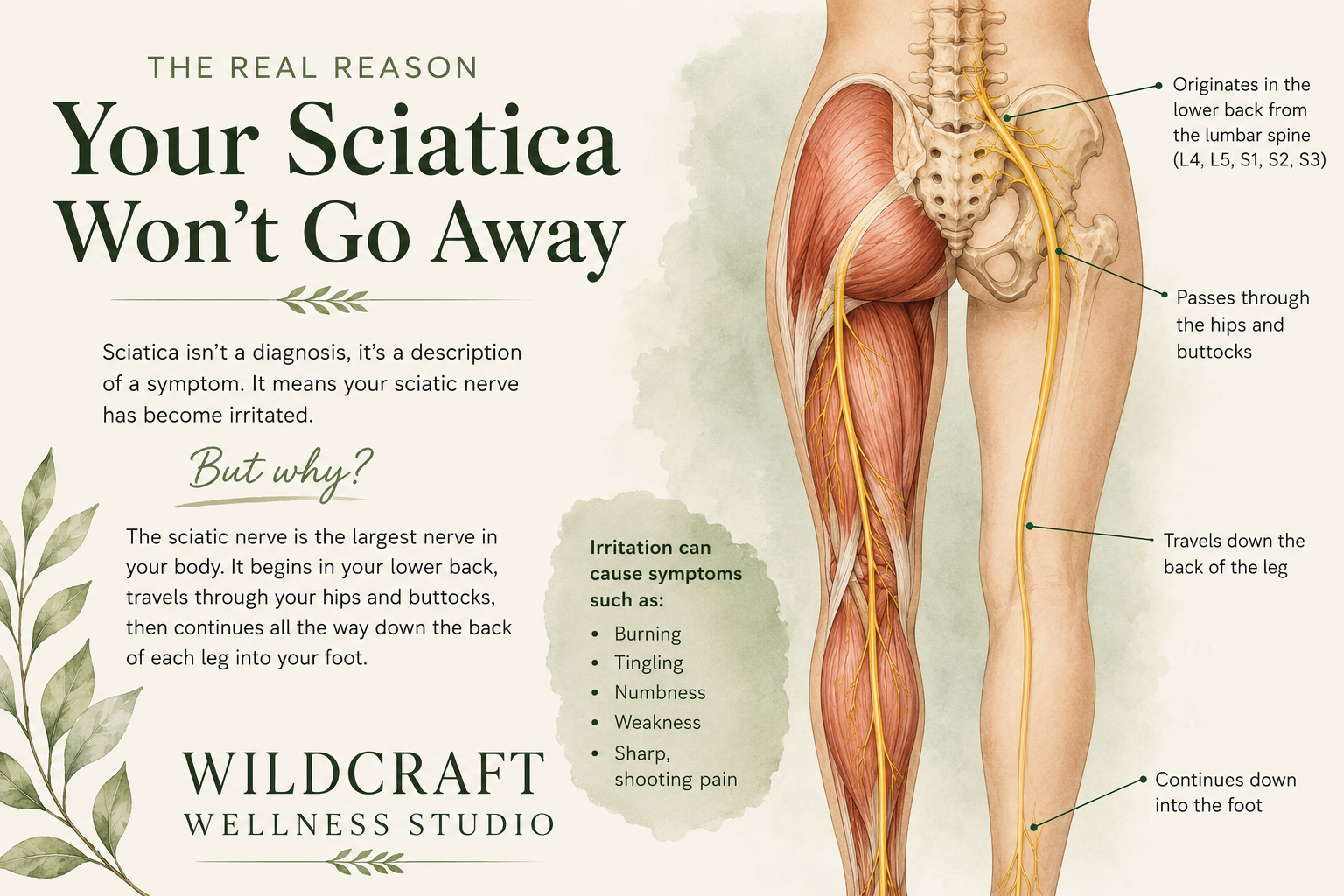
One of the biggest misconceptions is that sciatica is actually a diagnosis. It isn’t. Sciatica simply means the sciatic nerve has become irritated. The real question is, why is the nerve irritated? Once we answer that, we have a much better chance of finding lasting relief instead of simply chasing symptoms.
The sciatic nerve is the largest nerve in your body. It begins in your lower back, travels through your hips and buttocks, then continues all the way down the back of each leg into your foot. When that nerve becomes irritated, you might notice burning pain, tingling, numbness, weakness, or even a sharp, electric sensation running down your leg. Some people feel it mostly in their hip or buttock, while others feel it all the way into their calf or foot.
One thing I tell my clients all the time is that pain isn’t always where the problem is. Just because you feel pain shooting down your leg doesn’t necessarily mean that’s where I need to spend all my time.
Yes, a bulging or herniated disc can absolutely irritate the sciatic nerve, but that’s far from the only possibility. One of the most common things I see in my practice is a very tight piriformis muscle. The piriformis is a small muscle that sits deep in your glutes. In some people, the sciatic nerve travels underneath that muscle, and in others it actually passes right through it. When that muscle becomes tight or inflamed, it can compress the nerve and create symptoms that feel almost identical to a disc problem. This is called piriformis syndrome.
Our bodies are incredibly good at compensating. Usually sciatic pain isn’t caused by one dramatic event. It’s years of sitting too much, driving long distances, weak glutes, a weak core, tight hips, lifting incorrectly, old injuries, or muscle imbalances that slowly add up until your body finally says, “Okay, I’m done.”
Have you ever noticed your sciatic pain gets worse after a long drive, sitting at your desk all day, or spending an afternoon on the couch? That’s because those muscles stay in the same shortened position for hours. When you finally stand up, they’re stiff, tight, and if they’re already putting pressure on the sciatic nerve, you really feel it. Sometimes something as simple as standing up every 30 to 60 minutes and walking around for a couple of minutes can make a surprising difference over time.
When someone comes into my studio with sciatic pain, I’m not really chasing the nerve. I’m trying to figure out why the nerve is unhappy in the first place.
I usually begin around the middle and lower back, working through the erector spinae muscles and the quadratus lumborum before moving into the glutes. Then I spend quite a bit of time around the sacrum and the ischial tuberosity, better known as your sits bone, because that’s where I often find some of the biggest areas of muscle tension.
From there I work through the gluteus maximus, gluteus medius, gluteus minimus, and especially the piriformis muscle. I continue toward the greater trochanter on the outside of the hip, then down through the hamstrings and into the tissues surrounding the iliotibial, or IT, band. It’s amazing how often this entire chain of muscles becomes tight together. So, to offer real relief from sciatic nerve pain, the whole muscle chain must be addressed.
As those muscles begin to relax, they’re no longer placing as much pressure on the tissues surrounding the sciatic nerve. Many of my clients tell me they can feel the difference before they even get off the table. That’s why I don’t just massage where it hurts. I treat the entire pattern that’s contributing to the problem.
Once we calm everything down, the next goal is keeping it from coming right back.
One of the best things you can do is simply keep moving. Years ago people were often told to stay in bed with back pain, but we now know prolonged inactivity usually makes muscles tighter and recovery slower. Start with a five to ten minute walk at an easy pace. The goal isn’t exercise, it’s movement. As your symptoms improve, gradually increase your walking time. A little movement several times throughout the day is often better than one long walk.
Stretching can also be incredibly helpful, as long as it’s gentle. None of these stretches should create sharp, shooting pain. You should feel a gentle pull through the muscles, not pain traveling farther down your leg. If a stretch makes your symptoms worse, back off and let your body tell you what’s too much.
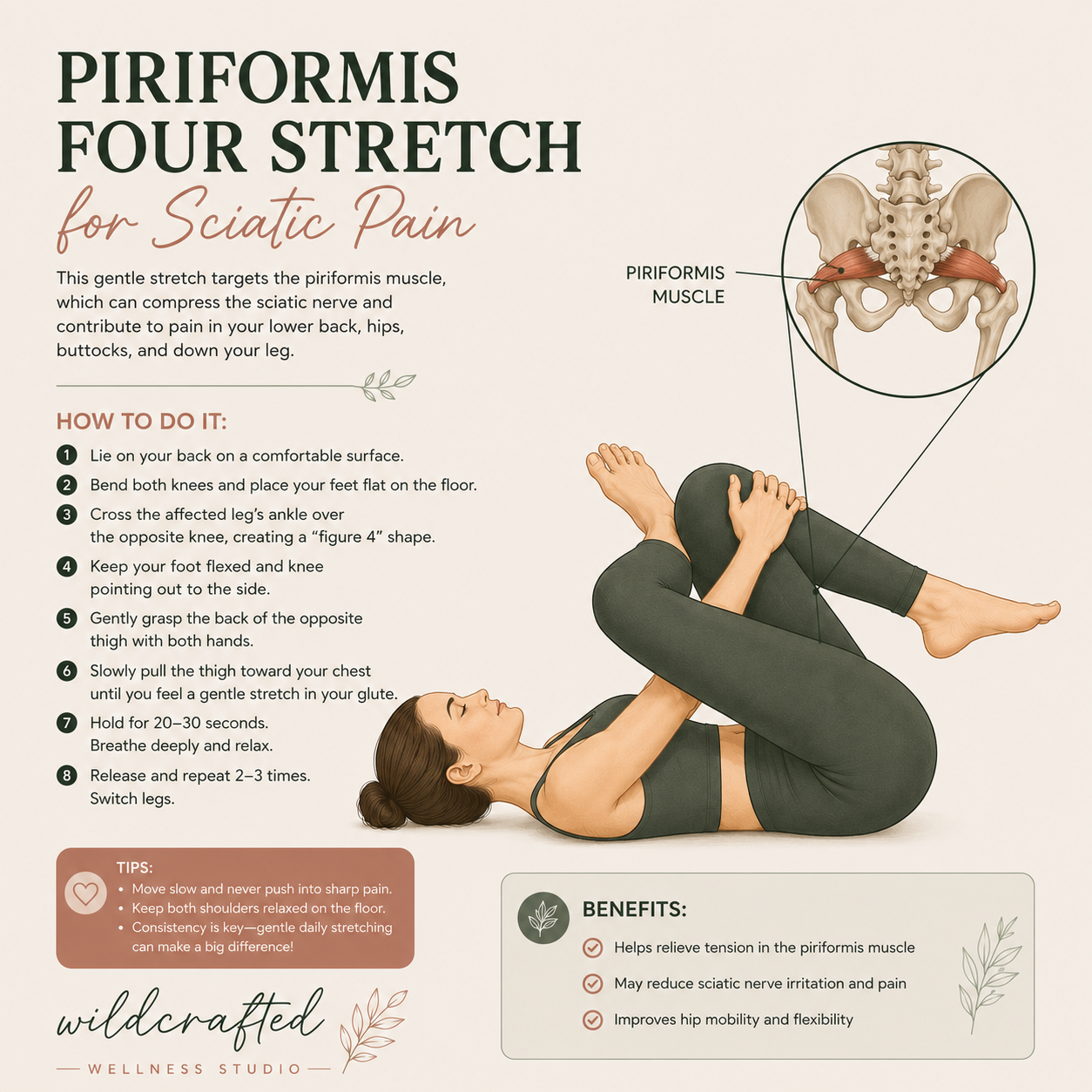
One of my favorite stretches is the Figure Four Piriformis Stretch because it targets one of the muscles most commonly involved in sciatic pain. Lie on your back with both knees bent. Cross the ankle of your painful side over the opposite knee so your legs form the number four. Reach behind your supporting thigh and gently pull that leg toward your chest until you feel a comfortable stretch deep in your buttock. Hold for 20 to 30 seconds while breathing normally, then slowly release. Repeat two or three times.
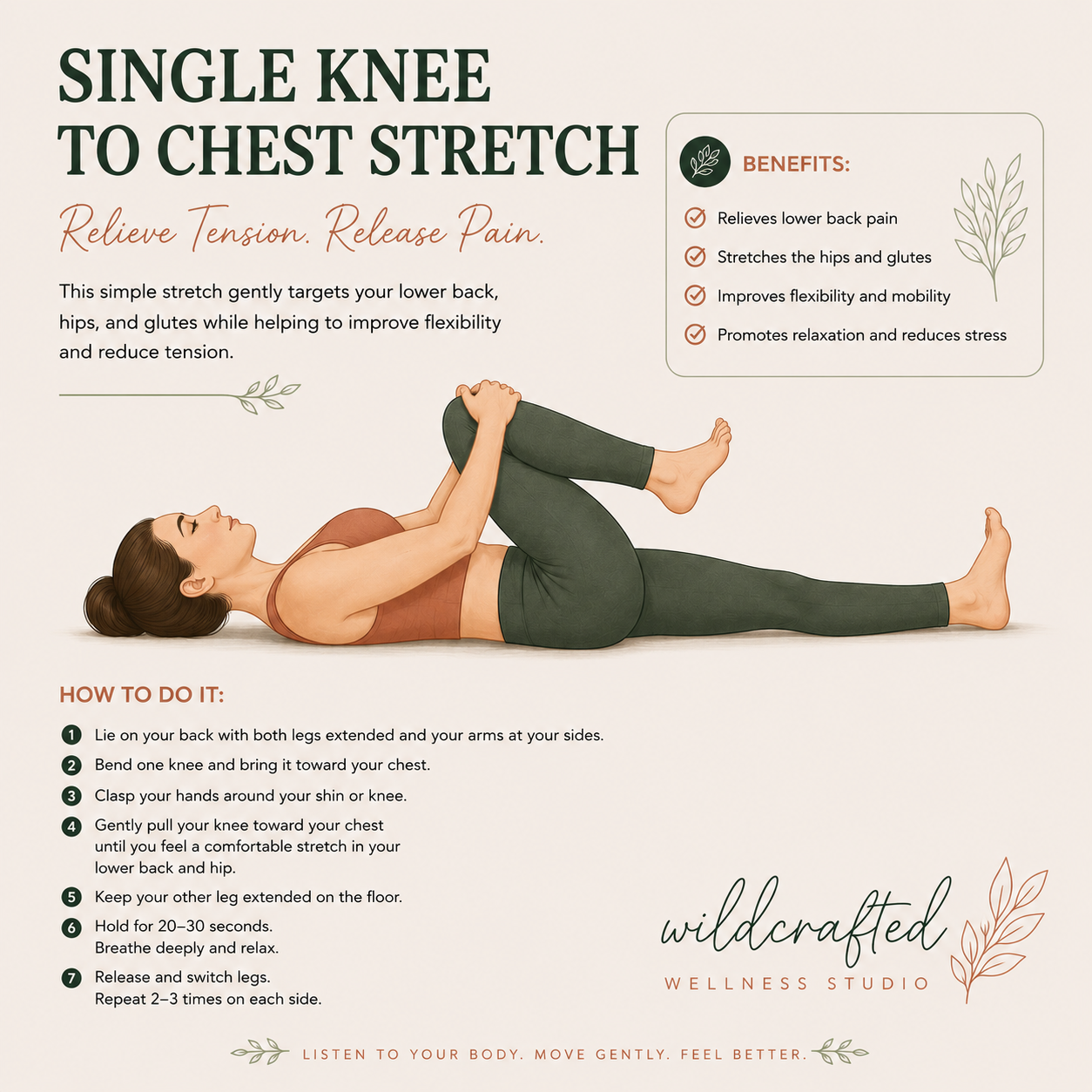
Another excellent stretch is the Single Knee to Chest Stretch. Lie on your back with both knees bent. Bring one knee toward your chest and gently pull it in with your hands until you feel a comfortable stretch through your lower back and hip. Hold for 20 to 30 seconds before switching sides. Repeat two or three times on each side.
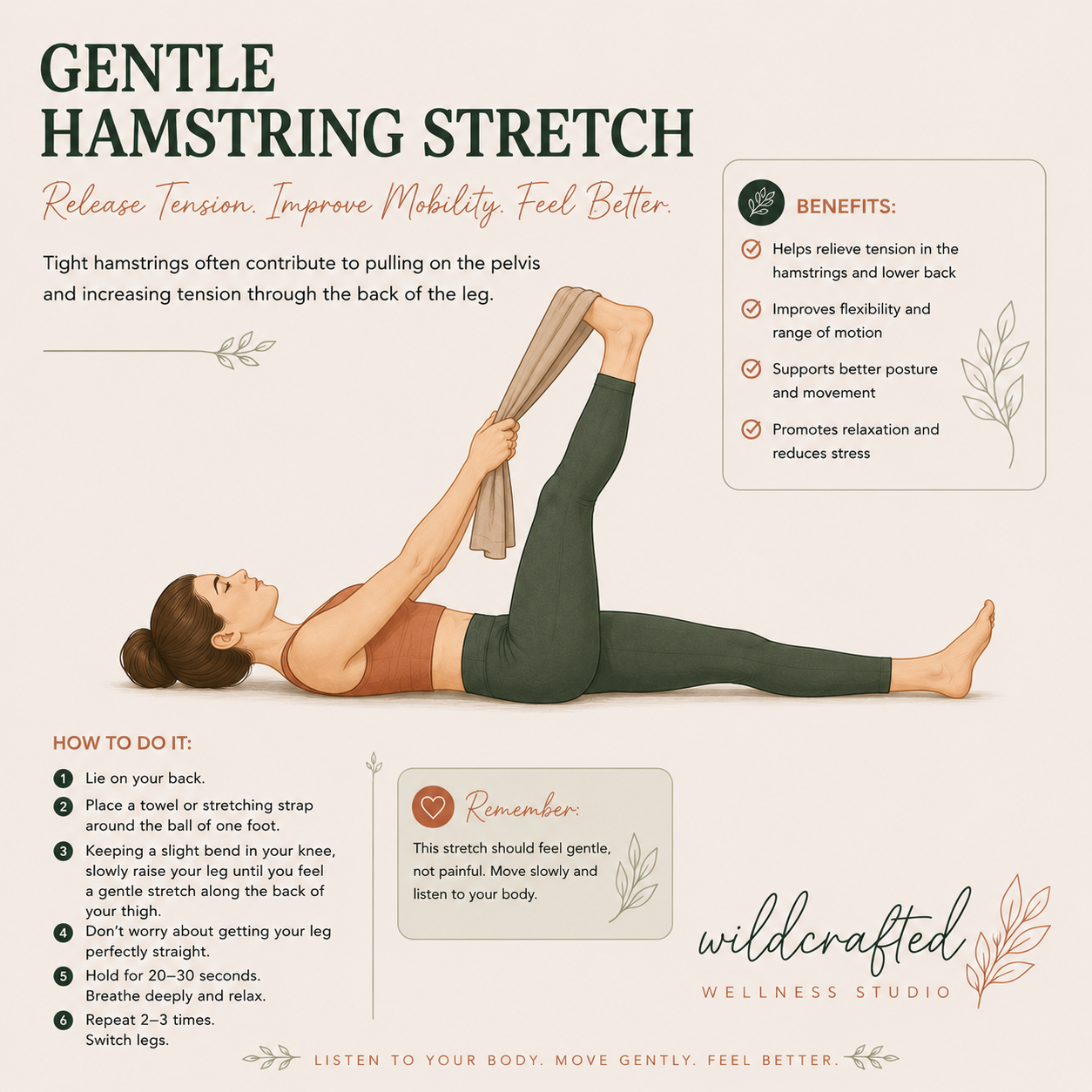
Tight hamstrings often contribute to pulling on the pelvis and increasing tension through the back of the leg. For a Gentle Hamstring Stretch, lie on your back and place a towel or stretching strap around the ball of one foot. Keeping a slight bend in your knee, slowly raise your leg until you feel a gentle stretch along the back of your thigh. Don’t worry about getting your leg perfectly straight. Hold for 20 to 30 seconds and repeat two or three times.
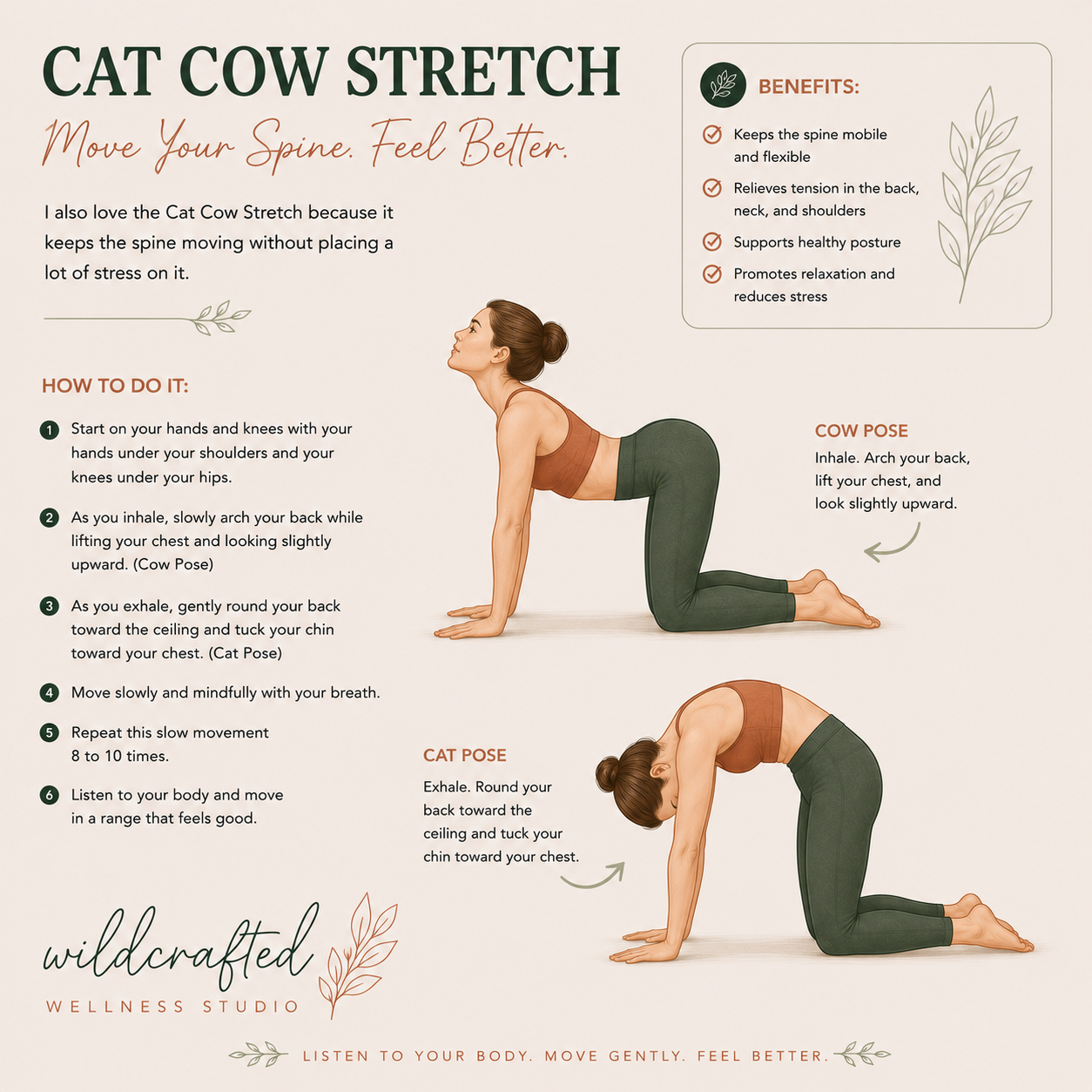
I also love the Cat Cow Stretch because it keeps the spine moving without placing a lot of stress on it. Start on your hands and knees with your hands under your shoulders and your knees under your hips. As you inhale, slowly arch your back while lifting your chest and looking slightly upward. As you exhale, gently round your back toward the ceiling and tuck your chin toward your chest. Repeat this slow movement eight to ten times.
People also ask me all the time what supplements they can take between appointments to help with sciatica. While there isn’t one magic supplement that fixes sciatic pain overnight, there are several things I’ve found helpful over the years.
If muscle tightness seems to be part of the problem, magnesium glycinate is one of my favorite supplements. Magnesium plays an important role in normal muscle and nerve function, and muscles that are low in magnesium often have a harder time relaxing after they contract. If you constantly feel tight, or you deal with muscle cramps, magnesium glycinate may be worth discussing with your healthcare provider.
I also like herbs that support the body’s normal inflammatory response, including turmeric, ginger, boswellia, and meadowsweet. They aren’t a replacement for proper treatment, but they can be another helpful tool when used appropriately.
Clients also ask me what products I personally keep around for aches and pains. One of my favorites is Curamin® by Terry Naturally. I’ve had wonderful experiences with it over the years for pain support. For topical relief, I also like Hyland’s Arnica®, Orthosport by Young Living, Cannabis Care®, and several quality CBD creams. These don’t fix the underlying cause, but they can make moving around much more comfortable while everything continues to calm down.
The biggest takeaway is this, lasting relief usually doesn’t come from one magic treatment. It comes from putting several pieces together. Massage therapy releases tight muscles. Gentle stretching helps maintain mobility. Walking keeps everything moving. Herbs and supplements may help support your body’s recovery, and topical products can make you more comfortable while you heal.
Of course, not every case of sciatica should be treated with massage. If you develop significant leg weakness, lose control of your bladder or bowels, experience numbness around your groin or saddle area, develop a fever with your back pain, or your pain follows a major fall or accident, those are signs you should seek immediate medical care.
One of the things I love most about massage therapy is getting to play detective.
Every body tells a story, and no two clients are exactly alike. That’s one of the reasons I still love what I do after all these years.
My goal isn’t just to help you feel better for an hour. My goal is to help you understand your body, identify what’s contributing to your pain, and give you the tools to keep it from coming right back.
If you’ve been dealing with sciatic pain, I’d love to help. Together we’ll figure out what’s contributing to your pain and create a plan to help you move more comfortably.