

Why do so many people fail to reach their goals? It’s not because we don’t have the information. Most of us know what’s needed to be the person we want to be or to get the life that we want. We lack follow through. Why do we struggle to stay consistent with anything that matters to us? Why do we make all of these New Year’s resolutions and two months into the year, we’ve already quit?
Almost every one of us has experienced the excitement of a new beginning. We buy the planner. We sign up for the gym. We clean out the pantry. We buy the books. We create the budget. We tell ourselves, “This time is going to be different.”
And for a little while, we’re motivated. We’re inspired. We’re excited about the possibilities.
Then life happens. Work gets busy. The kids get sick. We’re tired. We have a stressful week. The scale doesn’t move as quickly as we hoped. The business isn’t growing fast enough. The relationship still feels difficult.The motivation that carried us through those first few weeks quietly begins to disappear.
For many people, that’s where the story ends. The workout gets skipped. Then another one. The healthy meals slowly disappear. The savings account stops growing. The book gets put back on the shelf. And eventually we tell ourselves the same thing we’ve probably told ourselves dozens of times before.
“I just don’t have enough discipline.” …“I always quit.”…“I’ve never been consistent.”…“This is just who I am.”
But I’d like to challenge that belief. I don’t think that’s actually what’s happening. I think something much deeper is taking place. Your brain is doing exactly what it was designed to do.
One of the most fascinating things I’ve learned through studying psychology is that your brain is constantly trying to predict the future. Our brains are still pretty primitive and running on the same system that they have for millions of years. Your brain is trying to help you survive.
Your brain is always asking questions like:“What usually happens next?”…“What should I expect?”…“What pattern have we experienced before?”
Imagine you’ve tried to lose weight five different times. Every single time you’ve eventually regained it. Your brain notices. Maybe you’ve started a workout routine every January only to quit by February. Your brain notices. Maybe you’ve promised yourself over and over that you’ll stop procrastinating, but every stressful season sends you right back into avoidance. Your brain notices. After enough repeated experiences, something begins to happen.The brain starts making predictions.Not because they’re objectively true but because they’re statistically familiar.
So instead of saying, “I’ve struggled with consistency before,” your brain quietly changes the story into, “I’m just not a consistent person.”
Do you hear the difference? One is a description of previous actions. The other is tied to your identity. That’s an incredibly important distinction because the moment your brain begins treating a repeated experience as part of your identity, every future decision becomes more difficult.
If you believe you’re someone who always quits, then every difficult day feels like confirmation. If you believe you’re someone who isn’t disciplined, every skipped workout feels like proof. If you believe you’re someone who can never lose the weight, every fluctuation on the scale reinforces that belief. Eventually the belief becomes so familiar that it doesn’t even feel like a belief anymore.
It feels like a fact BUT IT ISN’T. It’s a learned prediction. And learned predictions can change. Your brain is way more flexible than you think. One of the most exciting discoveries in neuroscience is something called neuroplasticity. Neuroplasticity simply means that your brain has the remarkable ability to change throughout your life. Every thought, behavior, skill, or habit you repeat literally changes the structure and efficiency of your brain. The neurons that fire together repeatedly begin wiring together more efficiently.
Think about learning to drive. At first, it feels impossible. You have to consciously think about every little movement. Mirror. Turn signal. Brake. Gas pedal. Steering wheel. Looking for traffic. Watching your speed. It feels overwhelming. However, months later, you’re driving home while carrying on a conversation, listening to music, and somehow arriving in your driveway with very little conscious effort.
What changed? Your brain became more efficient because of repetition. Every repeated behavior strengthens the neural pathways responsible for that behavior.Your brain begins to automate what you practice consistently.
Here’s the tricky part though. Your brain doesn’t just automate healthy habits. It automates unhealthy ones too. It automates procrastination. It automates avoidance. It automates negative self talk. It automates emotional eating. It automates people pleasing. It automates perfectionism. It automate freezing when life feels overwhelming. Whatever you consistently practice, your brain becomes better at doing.
I used to get so discouraged by all of these behaviors that felt so automatic, until I learned that if the brain can learn a behavior or pattern, it can learn a new one. So the goal is not to work against the old pattern or old belief. It’s to learn a new one. You’re not stuck because of your past. Your brain has just been repeating a pattern.
This is why I don’t believe motivation is the answer. Motivation is also incredibly unreliable. Motivation changes with sleep, stress, hormones, work, relationships or even the weather. If your entire plan depends on feeling motivated, then your progress is going to rise and fall with your emotions. And emotions, by their very nature, are temporary. I think one of the biggest misconceptions in our culture is that successful people somehow wake up every day excited to do difficult things. I think they’ve simply learned that emotions don’t always deserve the final vote.
That doesn’t mean emotions don’t matter. They absolutely do. Our emotions carry important information. Sometimes they tell us we need rest. Sometimes they alert us to danger. Sometimes they remind us that something meaningful needs our attention. But emotions were never meant to become the decision makers for our entire lives.
So if motivation isn’t enough…If repeated failures have taught the brain to expect more failure… If our brains are capable of changing… Then what do we do instead?
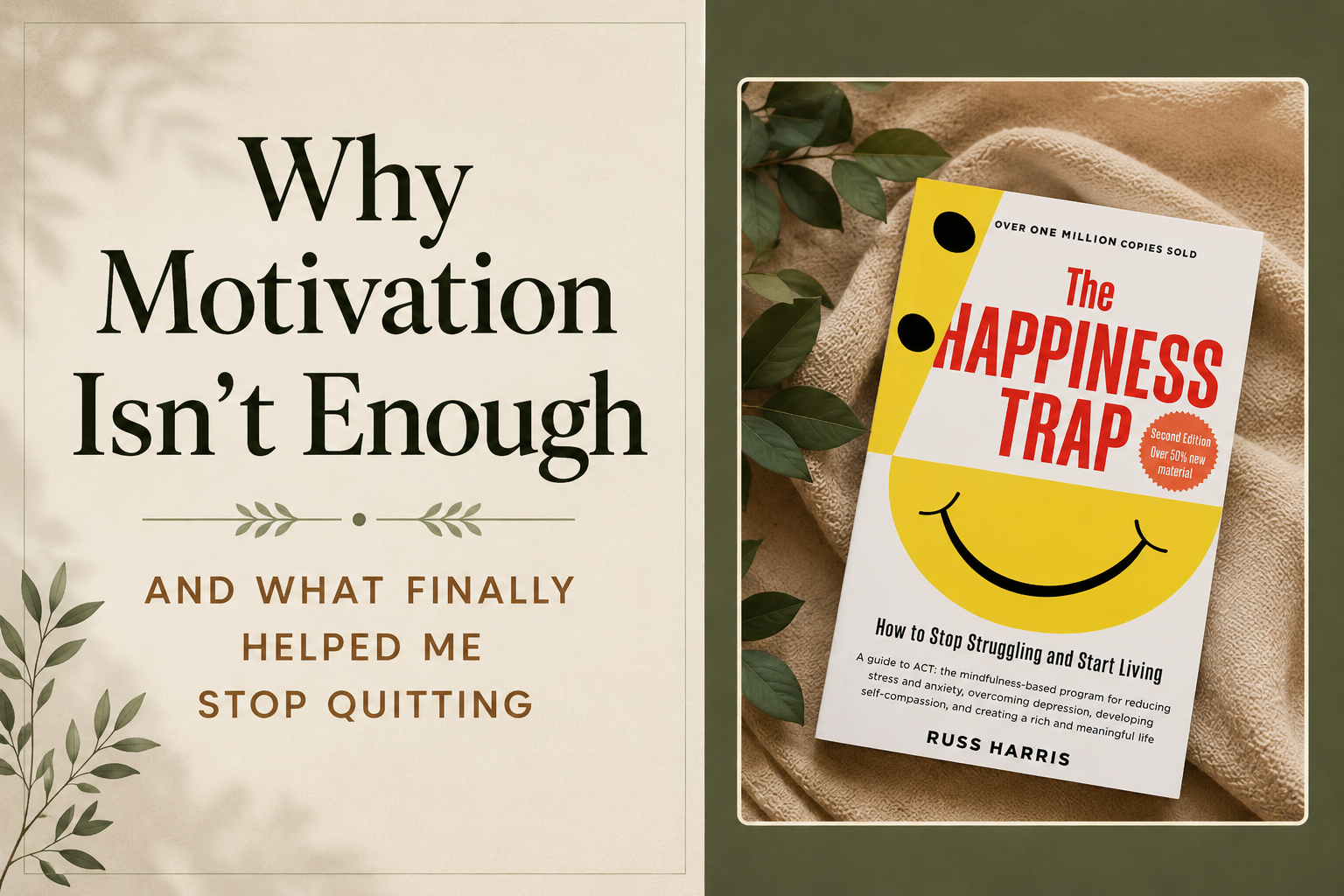
That question completely changed the way I think about lasting change. And it all started with a book I read years ago that introduced me to a completely different way of making decisions. The book is called “The Happiness Trap” by Russ Harris and is based on a psychological approach called Acceptance and Commitment Therapy (ACT). Unlike many self-help approaches that focus on trying to eliminate negative thoughts and emotions, ACT teaches something very different. It teaches us that difficult emotions are a normal part of being human, and instead of letting those emotions dictate our decisions, we can learn to acknowledge them while still choosing actions that align with our values. In other words, our feelings don’t have to be in charge. Our values can be. One of the exercises Russ Harris recommends in The Happiness Trap is taking the time to get brutally honest with yourself about the kind of life you want to build. Not the life other people expect from you.Not the life social media tells you to chase. Your life. Then write down the values that you want to guide the decisions you make every day.
I wrote this list years ago, but here are mine…
For me, integrity is one of my highest values. I want my words and my actions to match. My relationships are incredibly important to me, and I want the people I love to always know they can trust me. Education is another value. I never want to stop learning, asking questions, or challenging what I think I know. Open-mindedness matters deeply to me because I believe every person has a story, and I want to approach people with curiosity before judgment. I also value cleanliness because my environment affects my mental state. A peaceful space helps me feel peaceful. Health is important to me. I want to look and feel my best, even into old age. Honesty is another one of my core values. I don’t want to be someone who tells people what they want to hear simply to avoid discomfort. I want to tell the truth. I also believe truth should be delivered with kindness and compassion, but I never want fear of someone’s reaction to determine whether I’m honest.
Once I had written those values down, something interesting began to happen. Whenever a strong emotion showed up or an impulse tried to pull me in another direction, I stopped asking myself, “What do I feel like doing?” Instead, I started asking, “What choice moves me toward the person I want to be?”
For example, I share a lot of my life online, so I occasionally receive messages from men. Because integrity is one of my core values, I don’t respond in a way that could be interpreted as flirting or leading someone on. I also value relationships and because I value my partner, I always act in a way that honors him. There’s nothing that another person could do… There’s no temptation that could make me act outside of that value of integrity. Even when I’m mad. Even when we go through difficult seasons. I always act with integrity. Integrity has never been something that I have struggled with, but there are a lot of gray areas when it comes to male-female interactions, and after doing the work in this book, I hold very strong boundaries with myself on those interactions, that I probably didn’t before. I no longer have to stop and think about it, because I’ve already decided the kind of person I want to be. My values make that decision for me.
Another example is something much more ordinary. Sometimes I’ve cooked all day, the kitchen is a disaster, and I’m exhausted. Everything in me wants to leave the dishes until tomorrow. But cleanliness is one of my values because I know how much a clean environment contributes to my peace of mind. So instead of asking whether I feel like cleaning the kitchen, I ask whether cleaning it aligns with the life I’m trying to build. Most of the time, the answer is yes.
The beautiful thing about values is that they remove hundreds of little decisions from your life. You don’t have to renegotiate every choice every day. You’ve already decided who you want to become. Now your daily decisions simply become opportunities to practice being that person.
I’d like to challenge you to set aside an hour sometime this week. Turn your phone off. Grab a notebook and a pen. Then ask yourself some questions that most of us rarely slow down long enough to answer. Who do I want to become? When people experience my life, what do I hope they experience? What kind of parent, spouse, friend, coworker, neighbor, or human being do I want to be? What qualities do I admire most? What kind of character do I want to be known for? What kind of life am I actually trying to build?
As you answer those questions, you’ll begin to notice certain themes. Write those values down.Then write yourself a short values statement. Not a list of goals. Not a list of accomplishments. A description of the person you’re choosing to become. Keep it somewhere you’ll see it often. Put it in your journal. Take a picture of it and make it your phone wallpaper. Fold it up and keep it in your wallet or your pocket. Read it often because you have to remind yourself what matters most before life gets loud.
Then, when one of those big emotions shows up(and it will)pause before you react. Instead of asking yourself, “What do I feel like doing right now?”
Ask yourself, “What choice best reflects the person I’m trying to become?” Then make that choice. It might not feel easy. You might not feel motivated. The emotion may not disappear… but you make the choice anyway because you’ve already decided what matters most.
Those tiny choices matter far more than the big ones. Every time you choose your values over your emotions, your brain is learning. Every time you follow through when you don’t feel like it, you’re strengthening a new pathway. Every time you refuse to let a temporary emotion make a permanent decision, you’re teaching your brain a different way to respond.
This is how neuroplasticity works. The brain changes through repetition. One choice won’t change your life. But hundreds of tiny choices, repeated over weeks, months, and years, absolutely will. Eventually something incredible begins to happen. You no longer have to remind yourself to operate with integrity. You simply do. You no longer have to force yourself to clean the kitchen. You simply do. You no longer have to remind yourself to approach someone with an open mind before judging them. You simply do. The decision becomes easier because you’ve practiced it so many times that your brain has built a new default.
One day you’ll look back and realize you aren’t pretending anymore. You’re simply living in alignment with the person you’ve wanted to be all along. That’s how real transformation happens. Not through one grand decision or a brief period of motivation… but through thousands of small choices that slowly become your character.
And one day you wake up and realize you’re simply living the life that once felt impossible because, choice by choice, you’ve become the person who naturally lives it.
I can honestly say that that one book changed my life. I’m so proud of who I am as a person and how I operate in this world now. It took some soul-searching for me though, and I really had to determine what I value apart from what my family values or what my peers value. I had to authentically look at my internal landscape and dig deep. That self realization work was worth it as were all the thousands of tiny little choices I’ve had to make so that my daily actions line up with those values.
One of the best things you will ever do for yourself is to sit down and get really honest. Stop letting your emotions control your life or you’ll end up old, looking back, and never having lived the life that you wanted or never having become the person that you wanted to. You only get one life folks. I hope you make it one that you’re proud of.💗
Also, I can’t recommend this book enough. I have several more book suggestions that I’ll make in future posts but this is a good place to start.
If you’d like to read the book that introduced me to ACT therapy and values-based living, you can find it here:
The Happiness Trap:https://www.amazon.com/dp/B09PLYVTYS