

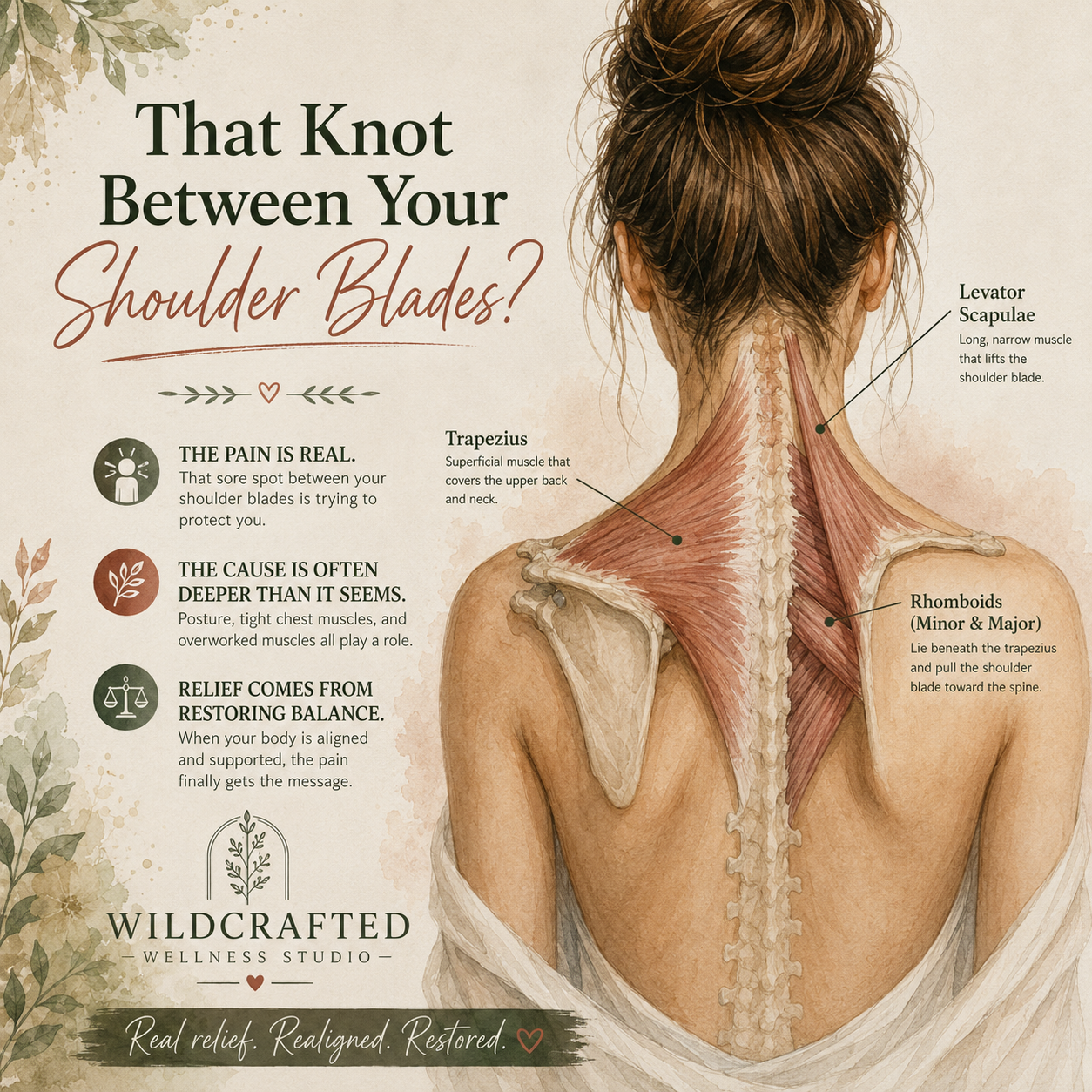
If I had a dollar for every client who pointed to the same spot between their shoulder blade and spine and said, “It’s right there,” I’d probably be retired by now.
It really is one of the most common complaints I see, and the funny thing is, it’s almost always the exact same area. Most people think that muscle just gets “knotted up,” but that’s usually only part of the story.
The muscles that tend to get blamed are the rhomboids, which sit between your shoulder blades and help pull your shoulders back. They work closely with the middle trapezius to keep your shoulder blades stable, while another muscle called the levator scapulae runs from the upper shoulder blade into your neck and helps lift the shoulder blade. If you’ve ever had pain that seems to travel from the top inside corner of your shoulder blade up into your neck, there’s a good chance that muscle is involved too.
Now think about how you spend your day. You’re driving. You’re typing. You’re looking down at your phone. Maybe you’re carrying a child on one hip, working in the yard, or sitting at a desk for eight hours. Almost everything we do puts our arms out in front of us. As our shoulders slowly roll forward, the muscles between the shoulder blades are constantly pulling backward, trying to keep us upright. They don’t really get much of a break.
Eventually they get tired. A tired muscle doesn’t always become weak and floppy. Quite often it does the opposite. It tightens. It becomes sore. It develops those tender little spots that everyone calls “knots.” Then we spend weeks trying to dig them out with a massage gun or a tennis ball, but because we’re never changing why the muscle is overworking, the knot comes right back.
This is also why stretching doesn’t always solve the problem. Sometimes those muscles don’t need to be stretched nearly as much as they need the muscles around them to start sharing the workload again. Opening the chest, strengthening the upper back, improving shoulder mobility, and simply getting up to move throughout the day can make a tremendous difference.
We also have to think about what’s happening on the front of the body. As the shoulders round forward day after day, the pectoralis major and pectoralis minor gradually become shortened and tight. It’s almost like they’re pulling the shoulders farther forward while the rhomboids, middle trapezius, and levator scapulae are pulling just as hard in the opposite direction, trying to keep you upright. It’s a constant tug-of-war. That’s why, when I treat this area, I don’t just focus on the muscles that hurt. Releasing the muscles across the front of the chest is just as important. As the pecs begin to lengthen and open, the muscles between the shoulder blades finally get a chance to relax instead of fighting that forward posture all day long.
One of my favorite treatments for the upper back area is therapeutic cupping. Unlike massage, where I’m compressing tissue with my hands, cupping gently lifts the tissue. That negative pressure helps increase circulation, allows the layers of fascia to glide more freely, and often gives those overworked muscles a chance to finally relax. I especially love combining cupping with massage in this area because it lets me work deeper without having to use painful amounts of pressure. Clients are often surprised that they leave feeling looser, even though the treatment was actually more comfortable than someone digging an elbow into the knot for an hour.
Of course, muscles aren’t the only piece of the puzzle. I can usually tell when someone has been carrying a lot of stress before they ever say a word. Their shoulders are elevated, their neck is tight, and their breathing stays high in the chest instead of down into the diaphragm. The rhomboids, trapezius, and levator scapulae end up working even harder because they’re helping stabilize a body that’s been bracing itself all day. Our nervous system and our muscles are constantly talking to each other, and one almost always affects the other.
Most people don’t realize how much their breathing pattern contributes to tension in this area. When you breathe shallowly into your chest, your neck and shoulder muscles have to assist with every breath. Over time, that constant extra workload keeps those muscles in a semi-contracted, overworked state.
Instead, try shifting your breath down into your diaphragm. As you inhale, let your ribcage expand outward and your belly gently rise. Your shoulders should stay relatively relaxed and quiet. This allows your diaphragm to do the majority of the work, taking pressure off the muscles around your neck and shoulder blades.
It might feel unnatural at first, especially if you’ve been breathing this way for years, but with a little practice it can make a huge difference. Slowing your breathing down and making it more efficient not only reduces muscle tension, it also helps calm your nervous system, which further decreases that constant bracing pattern.So the next time you catch yourself rubbing that spot between your shoulder blades, stop for a second and check in with your breathing.
If this has been a trouble spot for you for years and you feel like you’ve tried everything without getting consistent relief, it might be time to take a more complete approach. Instead of just chasing the knot, let’s create a plan together that actually addresses what’s causing it. That can include improving your posture, building a simple routine of stretching and strengthening exercises, and learning how to breathe from your belly so your neck and shoulders aren’t doing all the work. When you start putting those pieces together, that stubborn spot between your shoulder blades finally has a chance to calm down for good.